
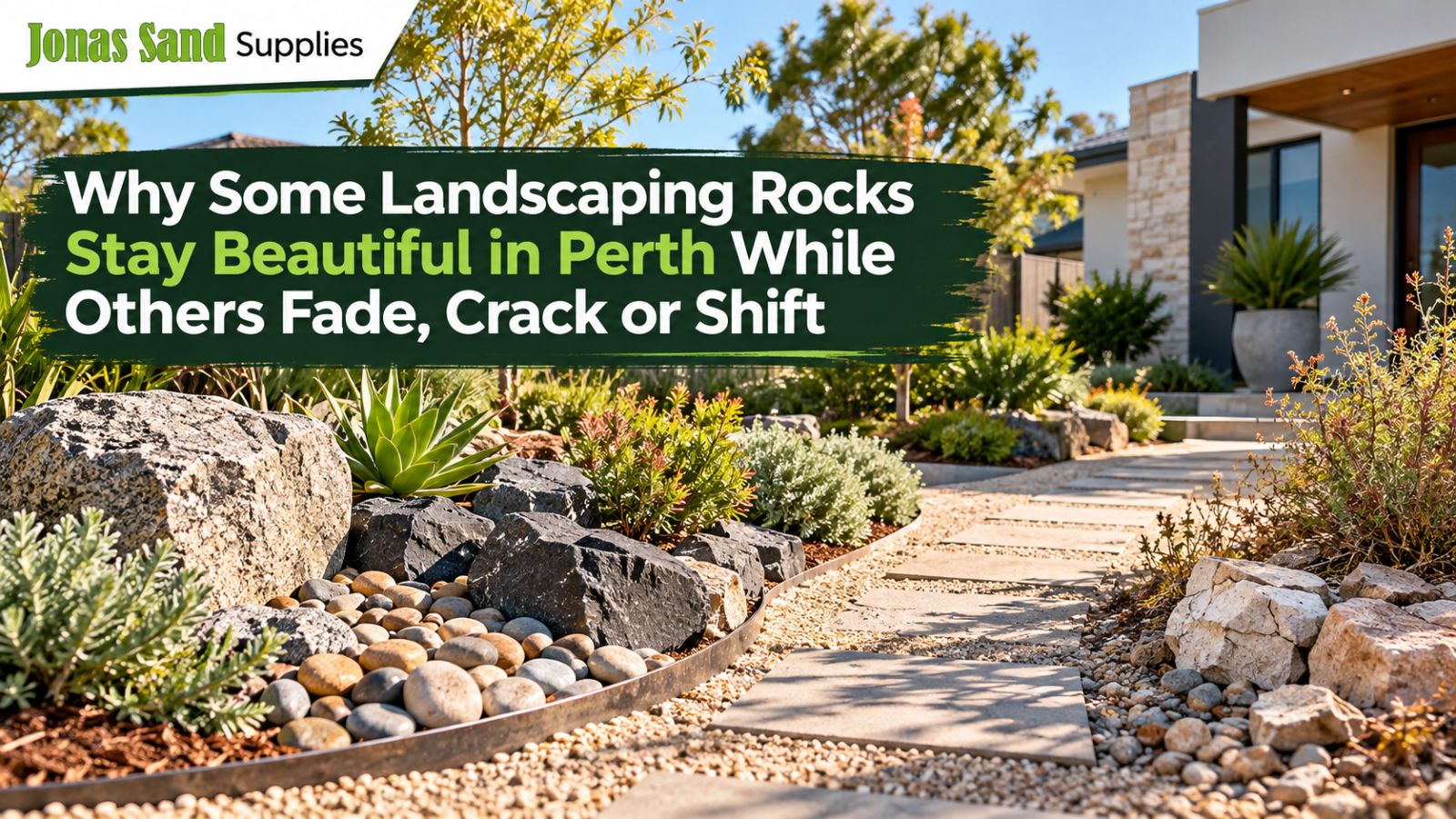
Homeowners in Perth invest heavily to create attractive gardens. But many witness these beautiful garden borders wilt, break down, or dissolve into the sandy soil within just a couple of years.
The relentless sunshine, ultraviolet radiation, and dramatic shifts in temperatures affect the garden materials. Low-quality sandstone is subject to temperature changes, and poor-quality aggregates become bleached and broken. High-quality stones stay strong and colourful. Choosing quality landscaping rocks in Perth can help create the most durable gardens.
Now there are eco-friendly landscaping supplies in Perth that can reduce harm to the environment. However, follow the points below to learn about the landscaping rocks used in Perth.
| Stone Category | Mineral Composition | UV / Heat Resistance | Ideal Outdoor Application |
| Quartzite & Granite | Metamorphic / Igneous | Exceptional; suitable for long-term outdoor use | Driveways and high-sun feature beds |
| Basalt & Lava Rock | Igneous volcanic | High thermal stability | Fire pit surrounds and weed control |
| Premium River Pebbles | Smooth siliceous | Natural colour retention | Water features and garden borders |
| Soft Sandstone / Shale | Sedimentary | Lower resistance; may fade or crumble | Shaded pathways and covered patios |
Among the cities in Australia, Perth is among those receiving the highest solar radiation. Due to ultraviolet radiation, the surface binding agents of the soft sedimentary rock break down. In cases where the temperature is about 40 degrees, and then the temperature falls quickly at night, thermal expansion causes small cracks in the stones.
| Failure Factor | Physical Impact on Garden Stone |
| UV & Extreme Heat Exposure | Can bleach artificial dyes and break down soft mineral binders. |
| Thermal Shock Expansion | Rapid cooling can create internal stress, cracks and surface flaking. |
| Soft Subgrade Soil Movement | Unstabilised stones can sink or shift in Perth’s native coastal sand. |
| Poor Drainage & Water Retention | Mineral leaching can leave white efflorescence stains on the stone surface. |
Superior landscape stone suppliers offer features of natural mineral colour throughout their structure rather than artificially dyed surface coatings.
The proper maintenance of stone gardens depends upon the preparation of the sub-surface soil. The loose and sandy nature of the soil can affect hardscape features. Without proper soil preparation, the heavy rocks become buried beneath the soil. This then needs constant replacement.
Remove all the topsoil and organic material at a depth of at least 75 mm. Compact the sandy soil thoroughly to provide a solid base before any rock installation can commence.
The installation of a commercially available high-power geotextile material will take place over the compacted sand soil. It creates a barrier between the natural soil and ground covering for proper drainage without sinking of stones.
Use a 30 mm road base or crushed aggregate while installing feature stones and gravel paths. This will ensure proper interlocking of the sub-layering to spread out the pressure from foot traffic.
Steel, aluminium, and concrete materials are recommended to be used as border edgings to avoid movement of loose stones caused by rainfall and lawn mower activities.
Contemporary landscaping practices focus on ecological equilibrium in addition to aesthetics. Use of eco-friendly landscaping supplies in Perth can help reduce carbon emissions in transport and support biodiversity.
| Sustainable Feature | Environmental & Garden Benefit |
| Locally Quarry-Sourced Stone | Reduces transport-related carbon emissions and complements the regional landscape. |
| Recycled Crushed Concrete Base | Diverts construction and demolition waste from the landfill and provides a durable sub-base. |
| Natural Unbleached River Pebbles | Avoids artificial colouring and can reduce the risk of chemical runoff. |
| Thermal Mass Rock Placement | Helps moderate soil temperature and can support moisture retention around plant roots. |
The selection of quality landscaping rocks in Perth depends on the compatibility between the physical characteristics of the stone and its function in your garden.
Finding landscaping supplies near me in Perth will provide you with a list of suppliers able to provide bulk materials suitable for local soils. Jonas Sand Supplies is one of them who can supply the best materials for landscaping.
A property owner in Scarborough replaced decaying pine bark mulch with premium local granite aggregate and ironstone boulders to combat coastal winds and intense sunlight.
| Metric | Organic Wood Mulch | Premium Local Stone |
| Initial Material & Installation | Low cost | Moderate initial cost |
| Annual Maintenance Requirement | Requires complete reapplication each year | Generally does not require regular reapplication |
| Colour Retention Period | 3 to 6 months | 10+ years, according to the provided comparison |
| Wind & Blowout Resistance | Poor; can move in coastal winds | Excellent due to greater weight |
| 5-Year Total Cost Comparison | Higher due to repeated material costs | Lower as a one-time investment |
He excavated 100 millimetres of topsoil and laid heavy geotextile fabric. Then he used a 50-millimetre layer of high-density granite chips. After five years, this yard has vibrant colours. It needs no new material and conserves hundreds of litres of water used for irrigation monthly.
Selecting quality landscaping rocks in Perth that property owners rely on is the single best way to ensure your outdoor space remains vibrant, durable, and low-maintenance throughout the year. Inferior materials crumble under the intense Western Australian sun. So, investing in high-grade eco-friendly landscaping supplies in Perth offers guarantees of long-term colour retention, optimal soil moisture control, and superior erosion protection. By choosing superior, locally sourced stones and preparing a solid geotextile base, you create a sustainable, elegant garden landscape that effortlessly withstands the elements for decades to come.
If you have exhausted yourself in searching for landscaping products near me in Perth, seek material guidance from Jonas Sand Supplies.
The stones of lower quality fade away since they are either coloured or dyed with artificial pigments or coatings. The strong UV rays of Western Australia will damage the coating or dye and will leave behind grey or white rocks. It is better to use the naturally occurring quality landscape rocks supplied by Perth companies to ensure that the colour is all through the mineral and it does not fade even when exposed to direct sunlight.
The decorative stones usually sink into the local sandy soil because the soil itself cannot carry much weight on its own and hence sinks under the pressure of footfall and rainwater. In order to avoid the sinking of the stones, one must remove the soil up to a depth of 70 millimetres and tamp down the sand underneath.
Since natural stone mulches are nonporous materials, they retain soil moisture very well in the warmest weather. The water used in irrigating them is not absorbed as much as wood chips would be. Wood mulch absorbs the much-needed water before it gets to the plants, but natural stones allow water to flow straight past them and down into the roots. Besides, ecologically sound gardening supplies I use in Perth landscaping do not decay, thus maintaining soil insulation by lowering temperatures of the soil.
Angular stones of 10 mm to 20 mm are the most suitable rocks for driveways and pathways. They have sharp edges that are firm enough to hold up under pressure. The rounded ones, on the other hand, will move around because of the pressure from either footsteps or vehicle wheels, causing slippery pathways over time. The quality landscaping rocks available in Perth will give me access to basalt or granite rocks that will stick together.
Determine the volume of rock by calculating the square metre of the garden bed, multiplying the length and width, and multiplying it again by the desired depth of 0.05 m for smaller rocks and 0.075 m for larger rocks. The result will be in cubic metres, which you then have to convert into metric tonnes by multiplying it by 1.5. This will help me purchase the required rocks without extra transportation costs.

Jonas Sand And Earth-Moving is a professional, reliable and affordable sand supply and earthmoving service. We know what it takes to transform your vision into a reality and we’re committed to being a part of that journey with our esteem clients